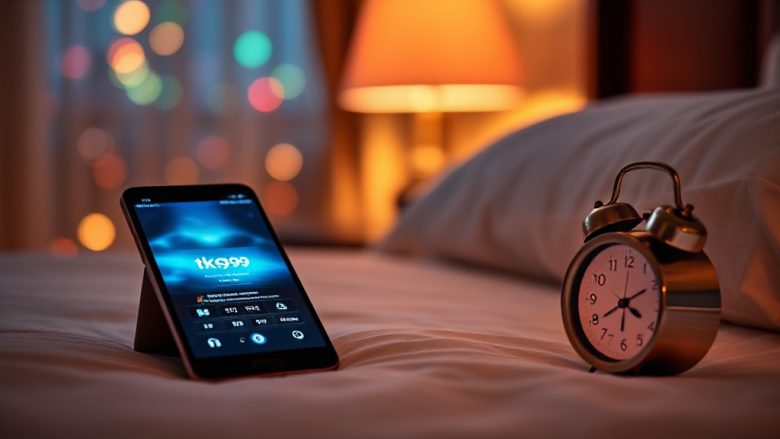
tk999 and the Late-Night Drift: Putting Betting Back in Its Slot
It is 1 a.m. and the phone is still glowing on the pillow. You did not plan to be awake this long, and nobody decided to keep going. The evening simply drifted, one small check at a time, until the clock had moved past midnight. On a platform like tk999, the question is rarely about willpower. It is about where the activity sits in the day, and what happens when it has no fixed slot.
This is a scheduling piece, not a lecture. The goal is simple: give betting a clear place in your routine so it stops borrowing hours from your sleep.
How the drift starts before midnight
The late-night drift almost never begins late. It begins in the afternoon, when a free half hour appears and gets filled with a quick look at the app. That look stretches, the evening plans soften, and by the time dinner is over there is no obvious stopping point left.
Phones make this easier than it used to be. A betting app is one tap away from a message, a video, or a news feed, so the boundary between checking something and settling in for the night disappears.
The three quiet triggers
- The leftover gap. An unclaimed 20 minutes after work becomes screen time by default.
- The second screen. The phone stays in hand while the television runs, so the session never really ends.
- The no-finish line. Without a planned end, the session ends only when you are too tired to continue.
None of these are dramatic. That is exactly why they work so well. The drift is made of small, reasonable decisions that add up to a very late night.
Giving daytime a real slot instead
The most reliable fix is not to resist the evening but to move the activity earlier. A daytime slot is easier to contain because it has natural edges: lunch, a commute, a gap between tasks. When the session has a start and a finish built into the day, it stops needing to spill into the night.
Pick a window that already exists in your routine, and treat it as the only window. Twenty to thirty minutes in daylight is usually enough for the checking, reading and deciding that people tend to stretch across four hours after dark.
What a daytime slot looks like
- Choose a fixed window, such as 1:00 to 1:30 p.m. or right after the workday ends.
- Open the app once, at the start of the window, and not before.
- Close it when the window closes, even if something is still unresolved.
- Leave the phone out of reach for the next hour so the habit does not reopen.
If you use the downloadable app, the notification settings matter more than the app itself. Turning off non-essential alerts removes the small prompts that pull you back in outside your chosen slot.
Evening boundaries and the sleep line
Evenings need a boundary, and the most useful one is a time, not a feeling. Feelings are unreliable at 10 p.m.; a clock is not. Decide in advance when the phone goes down, and make that time earlier than you think you need.
A practical rule is to separate the last check from the last hour. Whatever the final look at your account is going to be, it happens before the wind-down hour begins. After that, the phone charges in another room.
Signs the evening boundary is slipping
- You are still scrolling past the time you intended to stop.
- You check the app “one more time” after getting into bed.
- You wake up already thinking about yesterday’s session.
- Mornings feel rushed because the night ran long.
Any one of these is a signal to move the slot earlier, not to try harder at midnight. The point is to protect sleep, because a tired morning makes the next evening’s drift more likely.
A simple weekly review to keep the slot honest
Once a week, spend five minutes looking at when you actually used the app rather than when you meant to. A short review catches drift before it becomes a pattern, and it takes less effort than trying to rebuild the routine from scratch.
Ask three questions: which days did the session stay inside its slot, which days did it run late, and what was happening on the late days. The answers are usually practical — a stressful afternoon, a quiet evening, a phone left on the bedside table — and practical problems have practical fixes.
Adjust one thing for the coming week. Move the slot fifteen minutes earlier, put the charger in the hallway, or set a single reminder that marks the end of the window. Small changes hold better than grand resolutions.
Over a few weeks, the late-night glow on the pillow becomes the exception rather than the routine. Betting on tk999 fits back into the day where it belongs, and the evening returns to being an evening. That is the whole aim: not fewer hours awake, but better ones.